Amada compatible press brake tooling — what is it?
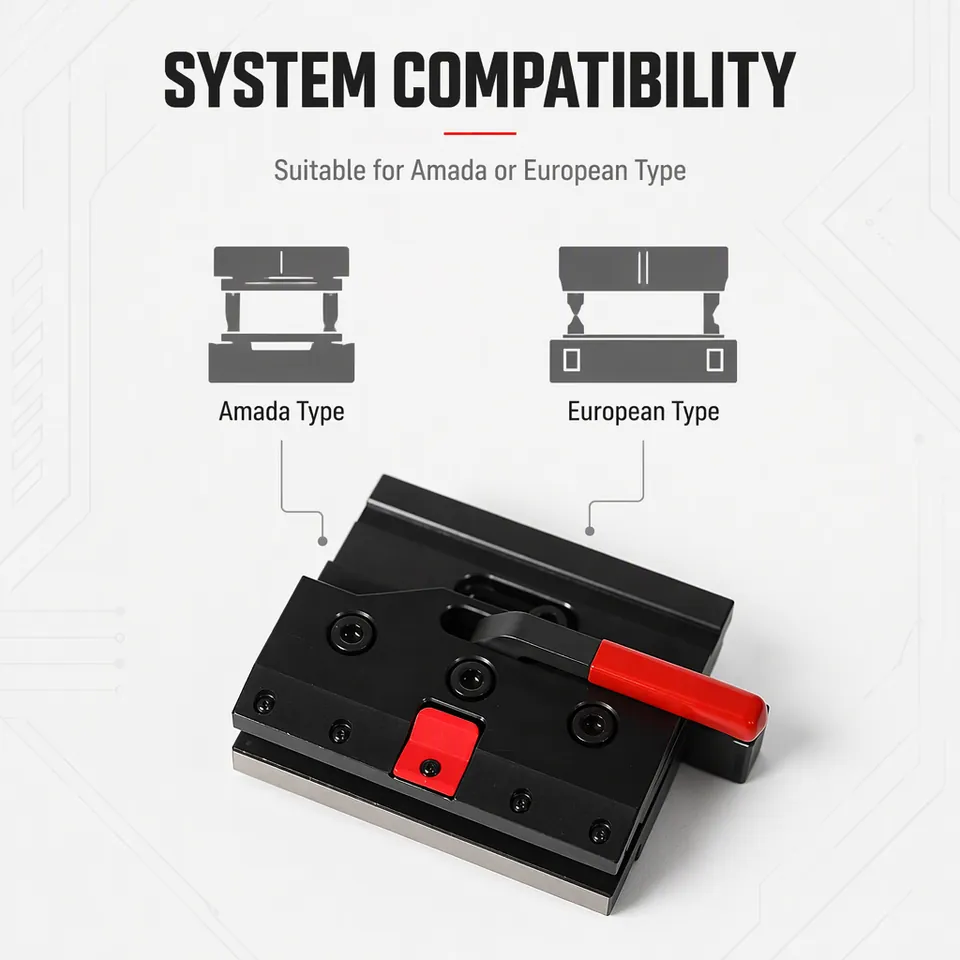
Amada-compatible press brake tooling uses a 13 mm tang with no safety shoulder, held in the machine clamp. The punch sits on the clamp face rather than locking into it, so the clamp alone retains the tool. Standard working lengths are built from 835 mm segment sets.
| Item | Reference value | Note |
|---|---|---|
| Punch tang | 13 mm | No safety groove or locking pin |
| Standard working length | 835 mm | Built from segment lengths |
| Typical segment splits | 10 / 15 / 20 / 40 / 50 / 100 / 200 / 400 mm | Plus a 10 mm end piece |
| Punch height | varies by profile | Common heights differ between standard and gooseneck profiles |
| Retention | Clamp only | No mechanical safety pin — check clamp wear |
Which profiles are available?
Profiles are supplied to the standard dimensions of the system, so they can be combined with existing tooling of the same system. Special profiles, radii and offsets are produced to drawing.
| Profile | Angle range | Typical use |
|---|---|---|
| Standard / straight punch | 28°–90° | General 90° bending |
| Gooseneck punch | 30°–88° | Return flanges, box and pan work |
| Acute punch | 28°–60° | Springback compensation |
| Sash / offset punch | 85°–90° | Thin frame and profile bends |
| Hemming / flattening punch | 0°–180° | Closing folded edges |
| Single-V die | 30° / 88° | Basic air bending |
| 2V die | 30°–90° | Two openings, no set screws |
| Multi-V die | up to 4 openings | Wide thickness range in one body |
What to check before ordering Amada-style tooling
- Clamp type. Mechanical, hydraulic and pneumatic clamps all accept the 13 mm tang, but clamp opening and wear change the effective height the punch sits at.
- Punch height. Mixing heights within one setup changes the shut height and can bottom out.
- Die base. Confirm whether your machine uses a plain base or a locating slot.
- Safety. Amada-style punches are not self-locking. Use a clamp in good condition and support long tools during handling.
Frequently asked questions
These are the questions buyers ask most often when specifying tooling for this system.
- What is the tang size of Amada press brake tooling?
- 13 mm. The Amada-style tang is 13 mm with no safety shoulder or locking pin, which is why it depends on the machine clamp for retention. Confirm the exact profile against your machine data sheet.
- How long is a standard Amada punch set?
- 835 mm total. Amada-style sets are commonly built from 10, 15, 20, 40, 50, 100, 200 and 400 mm segments, plus a 10 mm end piece, so any working length up to the full set can be assembled.
- Can Amada tooling be used on a Trumpf or Wila press brake?
- Not directly. Amada style uses a 13 mm tang while Trumpf and Wila use a 20 mm safety tang with locking pins. Adapters exist for some combinations, but confirm the clamp interface and safe retention before use.
- Why is 88 degrees used instead of 90 degrees?
- An 88 degree punch is used to over-bend slightly so that springback returns the part to 90 degrees. The correct over-bend depends on material, thickness and die opening.
Confirm the system for your machine
Send the machine make and model, or a photo of the punch tang and the clamp, and we will confirm the tooling system and quote standard or special tooling.
Email roger@sharktoolings.comRelated pages
The pages below cover the other tooling systems and the technical reference data used when specifying tooling.
- Trumpf / Wila compatible tooling — 20 mm safety tang with locking pins, in 100 / 415 / 835 mm segments.
- American style tooling — 1/2 in (12.7 mm) shank punches and heavy-section dies for Accurpress, Cincinnati, Pacific and Wysong.
- European style tooling — 13 mm tang and 60 / 80 mm die bodies for LVD, SafanDarley, Adira and Bystronic machines.
- Press brake tooling guide — profiles, shank standards and selection rules
- V-die opening selection chart — tonnage per metre and minimum flange