What is sectionalized press brake tooling?
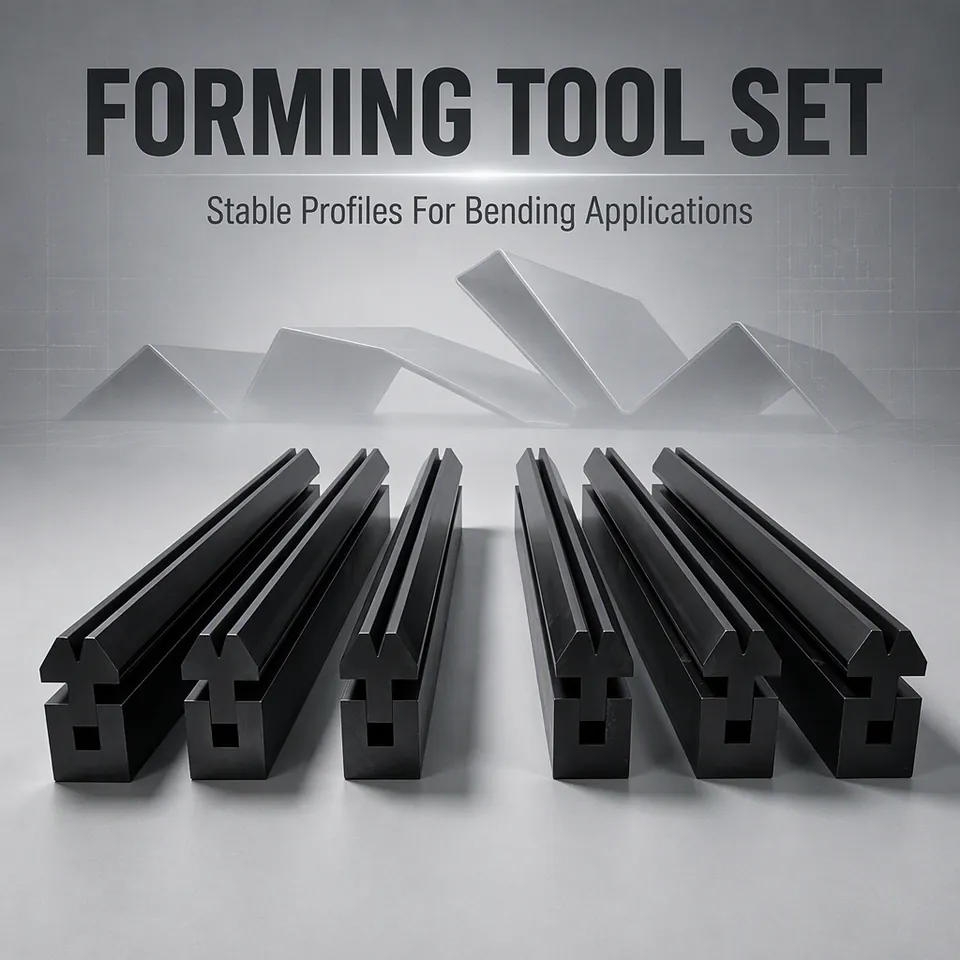
Sectionalized tooling is supplied in short segments that are assembled on the machine to build up the length the job needs. Segments let a tool set match a long bend, form a short bend, or leave a gap where an obstruction would otherwise be in the way.
What segment lengths are standard?
European and Amada tooling commonly use an 835 mm nominal set, and the Trumpf / Wila family uses 100, 415 and 835 mm segments so a range of lengths can be assembled from the same set.
| Family | Common segment lengths | How the set is used |
|---|---|---|
| Amada | 835 mm nominal set | Segments added or removed to match the bend length |
| Trumpf / Wila | 100 / 415 / 835 mm | Flexible build-up from three lengths |
| European | Commonly 415 / 835 mm | Similar build-up to Amada |
| American | Specified per job | Sections made to the required length |
How do I choose the segment lengths for a job?
Build the length from the longest segments that fit, and finish with short segments to reach the exact length. Leave a gap rather than shortening a bend where an obstruction has to clear the tool.
- Work out the bend length from the drawing.
- Choose the largest segments that fit within that length.
- Fill the remainder with the short segments available.
- Where an obstruction must clear, plan a gap in the set and check the load on the remaining segments.
- Seat every segment fully and clamp from the centre outwards.
Does segmenting reduce the load the tool can take?
It reduces the load that a short segment can take on its own, but not the load the assembled set can take, provided the segments seat properly and the load is distributed. A single isolated segment carries much less than the same length inside a full set.
Why does a segmented set give an uneven bend?
Usually because the segments are worn to different heights or are not seated fully. Regrinding segments at different times is the classic cause of a step or a varying angle along the bend.
| Fault | Effect on the bend |
|---|---|
| Mixed wear between segments | Step or angle change where the segments meet |
| Segment not fully seated | Local angle error at that position |
| Wrong segment order | Long segment loaded on its own |
| Gap used without checking load | Overload of the remaining contact length |
Related technical pages
Press brake punches
Profiles and how segments are specified.
Press brake dies
Die types and body widths.
Regrinding guide
Why mixed wear causes an uneven bend.
Tooling setup guide
Seating and clamping a segmented set.
Next step
Tell us the bend lengths you run and we will propose a segment combination that covers them.
Request a quotation